Author: Anvi Bhaduri

  • Building Our Future

    This is the final blog in this trilogy on the fascinating world of quantum physics, and yes, quantum mechanics has opened my eyes to a whole dimension of possibilities. In fact, quantum mechanics is a field of science that we use all the time. If I am being honest, it is probably something that we rely on a bit too much. So, what is the biggest use case of quantum physics in today’s day and age? Quantum is responsible for all the buzz around AI. All the top companies like Microsoft, IBM and DeepSeek are working on a branch of computing called quantum computing that can not only help progress AI but do things that even normal supercomputers would find impossible.

    Quantum computing is an emerging field of computer science that harnesses the unique qualities of quantum mechanics to solve problems beyond the ability of even the most powerful classical computers. It can solve problems that a normal computer could never solve, in a matter of months. They are being used for complex tasks that we could never imagine understanding, for example, to cure cancer through simulations or representing protein folding for doctors and biologists respectively (both of which I have been told are very complex areas of science). Both of these issues were considered impossible but necessary to tackle and now with the help of these super computers, the possibility dawns closer.

    Quantum computers have two main responsibilities: modelling the behaviour of physical systems as well as identifying patterns and structures in information; something humans and computers can do, but the efficiency of a quantum computer is unmatched.

    The four most important principles when thinking about quantum computing is superposition, entanglement, decoherence and interference. The most important of which is superposition, which derives from the basics of quantum mechanics, the theory of Schrodinger’s cat. The principle of superposition is when two or more waves overlap, the resulting disturbance is equal to the sum of individual disturbances, but each wave does this without affecting one another which means their characteristics stay independent. Simply speaking, imagine touching the surface of a lake at two different points at the same time. The waves would spread outward until they eventually overlap. This is a superposition of water waves, but this same concept can happen with any waves. In mathematical terms it is a similar concept to how a square root can have two possible solutions, e.g. the square root of 9 can be 3 or -3.

    When an electron is in superposition, its different states can be thought of as separate outcomes each with a different probability. However, the outcome is only known until it happens which is when the superposition collapses. It is science’s way to be able to exist in multiple different states at the same time.

    Sunlight itself is a superposition of light. White light which we see from the sun and most man-made light sources, is a superposition of all the colours. The formation of a rainbow occurs when the superposition collapses as the light is refracted through rain droplets. There have been many experiments to prove this idea, theoretical and physical. The most famous example being the Double Slit Experiment carried out by Thomas Young.

    Superposition is enormously important in quantum computing as this is how these machines store data. Rather than storing data in a bit, the smallest unit of data represented by a 0 or 1, they store data in qubits. These qubits are often created by manipulating and measuring quantum particles specifically photons and electrons as they are very small. A qubit is special as it can store data as a 0 and a 1 until it is measured. Therefore, the possibilities of storage can be 0, 1, 00, 01, 10, 11. As you can imagine, if one qubit holds so many combinations, and each combination represents a bit of data, then you can store vast amount of data with the same number of bits. When someone wishes to access this data, the multiple states collapse to form one single binary bit possibility, where it can be registered as a 0 or a 1.

    Quantum mechanics is a growing part of our world and frankly where all the new innovations and discoveries lie, as well as the fascinating new world of AI. Qubits could be the secret to an eco-friendlier way of storing data without thousands of litres of water wasted cooling the data centres. If like me, you are interested in science mixed with two of the most relevant subjects, climate change and AI, then this is where our future understanding lies. Quantum mechanics is a fundamental part of all modern studies, and I believe that quantum computing in particular is a field that requires more great minds.

    If you found this interesting and would like to read more on the subject I would recommend these websites;

    What Is Quantum Superposition? – Caltech Science Exchange

    Principle of superposition | Definition, Examples, & Facts | Britannica

    What Is Superposition? (Definition, Examples) | Built In

    What is a qubit? | IBM

    What Is Quantum Computing? | IBM

    What is Quantum Computing? – NASA

    Difference Between Bits and Quantum Bits – GeeksforGeeks

  • Particles Beyond Reality

    SPOILER ALERT: This blog is the theoretical context to my third blog in this trilogy. If you are confident with fundamental particles in quantum mechanics and the theories around empty space, please read my third blog, Building our Future.

    Everything around us, from stars and planets to the screen you’re reading this on, is built from a collection of fundamental particles. While quantum mechanics revealed that light and energy behave in unexpected ways, it also opened the door to a deeper understanding of matter and particles itself. For centuries, atoms were believed to be the smallest building blocks of matter, but we now know different. Beneath them lies a hidden world of quarks, gluons, leptons, and quantum fields – particles, and forces so small and strange that they challenge our perception of reality itself.

    In the early 1960s, it was proved that protons and neutrons were not the fundamental particles that we thought they were. Instead, they were made up of even smaller particles known as quarks. It is said that at the point of the Big Bang, only quarks and leptons (electrons) existed. These quarks then fused together to form larger particles, protons and neutrons. Along with the electrons, the first element, hydrogen, was created.

    There are 6 flavors (types) of quarks. The two most common ones are an up quark which has  a charge of 2/3 and a down quark with a charge of -1/3. A proton is made up of 2 up quarks and 1 down quark as it has an overall charge of 1. (+2/3 + 2/3 − 1/3 = +1). A neutron is made up of 1 up quark and two down quarks as it has an overall neutral charge. (+2/3 − 1/3 − 1/3 = 0). There are also strange quarks and bottom quarks both of which have a charge of -1/3 and charm quarks and top quarks both of which have a charge of +2/3.

    Quarks fuse together to form proton, neutrons, kaons, or other strange particles (hadrons). A strange particle is the umbrella term for all groupings of quarks as quarks never exist in isolation. They come in two forms, baryons, or mesons. This is because each quark can come in 3 ‘colours’, red, blue, or green. They are not actual colours as quarks are smaller than the wavelength of visible light, but they behave in a similar way. Nature, however, prefers colourless combinations which is why all the colours join together in the electromagnetic spectrum to make white light. Quarks do something similar. Blue, green, and red quarks fuse together to form a baryon. Here the colours cancel out leaving a ‘white’ baryon. Protons and neutrons are types of baryons.

    Quarks can also fuse with an antiquark of the same colour to form a meson. Antiquarks are the antimatter counterparts of quarks. They have the same mass as their corresponding quark but possess opposite properties, such as electric charge and colour charge. For example, while an up quark has a charge of +2/3, an anti-up quark has a charge of -2/3. When a quark and an antiquark bind together through the strong force, they form a particle known as a meson. The colour charge of the quark is cancelled by the corresponding anti-colour of the antiquark, producing a colour-neutral particle. Examples of mesons are pions and kaons. A pion is 270 times heavier than an electron and a kaon is several times heavier than a pion.

    The strong force becomes stronger as quarks are pulled apart which is what makes them unique. Unlike gravity which gets weaker when two objects are further apart; quarks actually behave in an entirely opposite manner. Gluons are massless elementary particles, and these are the particles that bind quarks together through the strong force. Shortly after the Big Bang, quarks and gluons existed in an extremely hot state known as plasma. The pressure and temperature were so high that these fused with leptons to form hydrogen. These hydrogen atoms then fused together through nuclear fusion to create heavier elements.

    If the strong force is carried by gluons, and all forces have a particle carrier then what about gravity? This question led physicists to find the hypothetical particle the graviton. They mediate the force of gravity and along with gluons and photons these particles do not feel gravity as they are massless. This was an influential discovery as before this most scientists believed that gravity was an exception to all forces, however, a big challenge remains. No graviton has ever been detected, which means they remain a mere theory.

    This particle highlights how much we still have to learn and discover, not only about particles but about something that we thought was simply nothing. After 1909, due to Ernest Rutherford’s alpha particle scattering experiment scientist believed that most of an atom was empty space as nearly all of the alpha particles passed straight through the atom. However, later experiments discovered that empty space was not empty space at all. It is full of quark and gluon fluctuations.

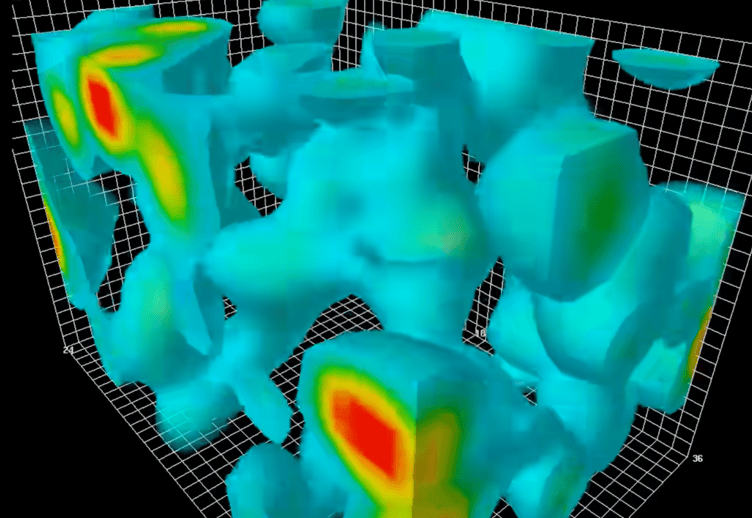
    Professor Derek Leinweber of the university of Adelaide designed a simulation to show these fluctuations. He used a supercomputer which is one of the fundamental uses of quantum mechanics. This is a map of the energy densities of gluon field fluctuations. Where there are red spots the energy density is very high, and the lighter green spots have a lower energy density. These fluctuations happen so quickly that the frame rate for this simulation is 1 followed by 24 zeros frames per second (1,000,000,000,000,000,000,000,000). The average frame rate for a YouTube video in contrast is 30fps.

    This is a simulation of vacuum alone. It is actually full of these fluctuations happening all the time. However, it is possible to create a true vacuum by clearing out all fundamental particles but a little hitch in the plan, is the amount of energy required to actually do this. And even if you did manage to acquire this much energy, you would find that a truly empty vacuum is unstable and would resort to its stable form with field fluctuations very quicky.

    This demonstrates just how poorly we understand the universe around us. Quantum mechanics has opened the door to an entirely new realm of mysteries. It forces us to rethink our assumptions and view reality from a completely different perspective. After all, how many people would imagine that something as seemingly empty as a vacuum is actually filled with fundamental particles and quantum activity? As strange as these discoveries may seem, they are only the beginning. Our journey into the quantum world has just begun, and its greatest secrets still lie ahead. We are yet to find out how they fit with classic Newtonian physics or even our modern lives, but quantum mechanics has proven useful in new inventions which would not be possible if not for the laws of quantum.

  • The Beginning of the Unthinkable

    The first blog in a three part series on the modern marvel of the century: quantum mechanics.

    But what exactly is quantum mechanics, and why has it fascinated scientists for over a century? From the strange behaviour of particles such as photons and quarks to the possibility of revolutionary technologies like quantum computers, quantum mechanics lies at the centre of some of the most exciting ideas in modern science. Understanding it means stepping into a world where the rules of everyday life no longer seem to apply. Albert Einstein himself had a love-hate relationship with the idea. It challenges you to forget everything you think you know and embrace the unthinkable.

    Quantum mechanics is probably the second most sought-after field in physics, following astrophysics. It is where ground breaking theories emerge, strange ideas challenge our understanding of reality, and physicists dream of having a discovery or theory named after them.  Recently, quantum computing has pushed quantum mechanics further into the spotlight, with new breakthroughs and mysteries appearing almost every year.

    Quantum mechanics is the description of the behaviour of subatomic particles such as photons and electrons, how they work and how they interact with light. Richard Feynman, a physicist in the mid-1900s said that particles are particles (not waves) and they can hop from place to place with a particular probability. To calculate the probability that the particle will be at a different place later is as follows: assign a probability to every point in the room and then add them up. This is called the path integral formulation and can be used to calculate the probability of a particle travelling from point A to B. If a particle travels from one corner of a room to another, the path integral formula can be used to calculate what the probability of that particle moving to another point in the room is.

    Before the turn of the 20th century, scientists believed light was a transverse wave and particles could never be waves. According to Newtonian physics a hot object should emit infinite energy at short wavelengths. Red light gives out some energy; blue light gives out more energy and tiny wavelengths like ultraviolet gives out huge amounts of energy. Their math stated that a hot object should pour out endless energy in tiny wavelengths. However, there are some clear problems with this theory as it would mean some objects would have infinite energy which means, that energy would come from nowhere. We now know that this would go against the theory of conservation of energy and evidently made no sense. Their mistake became known as the Ultraviolet Catastrophe.

    Max Plank in 1900 had a bold idea. He said that light energy does not come in smooth endless amount but instead it comes in tiny packets, called quanta. For example, you cannot use half a coin, you must use a whole coin. This idea meant that very tiny wavelengths need bigger energy packets (quantum), which meant that shorter wavelengths emitted more energy.

    Einstein expanded on this further. He thought, what if light itself was made up of quanta. The colour of the light tells you how ‘energetic’ it is. The shorter the wavelength, or the more purple the colour, the stronger the packets. So, in theory a blue hot iron would actually emit more energy than a red-hot iron. Einstein used this to explain the photoelectric effect. This is when shining dim blue light on metals could knock electrons out, but very bright red light sometimes could not. This led Einstein to believe that the energy was not about the total brightness, rather about how strong each tiny packet is. The blue light had a small number of large packets, and the red light had a large number of small packets. He called these energy packets, photons.

    Photons are a massless particle which means they do not feel a gravitational attraction. They move at the speed of light and have no rest mass; this means that a photon is always moving at the speed of light. These photons sometimes acted like waves and sometimes acted like particles. This meant that tiny particles could be in many possible states at once and its state only becomes definite once measured.

    This arises from Schrödinger’s theory that a cat can be both dead and alive at the same time. He imagined that a cat is placed in a box with radioactive material that has a 50% chance of killing the cat in the next hour. At the moment just before you open the box, the cat is both alive and dead at the same time. It is only once you open the box that the cat’s single state is visible. This quantum theory perturbed Schrödinger so much that he gave up physics and moved to biology.

    Quantum mechanics began as an attempt to explain strange mysteries about light and atoms which normal Newtonian physics simply could not explain, but it ended up completely changing our understanding of reality itself. From photons and wave-particle duality to uncertainty and superposition, quantum theory reveals answers to problems that had bizarre solutions earlier. Although many of its ideas seemed confusing at first, quantum mechanics has helped scientists build technologies like lasers, computers, and MRI machines, while also opening the door to future innovations such as quantum computing. Most importantly, it reminds us that not all questions are answered and certainly not all questions have arose.

  • Wonders of our Past

    As a Londoner, I often find myself comparing the regal Victorian architecture in places like Bank and Regent Street to the high-rise modern apartments in Southwark and Canary Wharf. The beauty of the regency architecture is unparallel as it brings a sense of class and grandeur. In contrast, the modern skyline is functional with its ergonomical design. No points for guessing my favourite form – keeping the classical architecture but adding the necessary modern twists (like insulated walls and draft management). However, thinking about architectural science, there is little comparison of the wonders created thousands of years ago. When compared, one could argue that the application of geometry and its execution may not have attained the same level of precision as witnessed 4000 years ago.


    Take the pyramids of Giza. It is common knowledge that the stones used were enormous and weighed around 15 tons each. Without modern cranes, transporting these boulders is a massive feat in itself. However, it is only when we look closer that we can truly marvel at the oldest wonder of the world. If one took the slanting height of the pyramid and divided it by half of the length of the base, you get a number suspiciously close to the golden ratio (about 1.68). To highlight the magnitude of this discovery, the golden ratio (phi) was only discovered by the Greeks 2000 years later. It creates a mathematically perfect monument with visually appealing proportion. It also has close links to the Fibonacci sequence as the ratio of consecutive Fibonacci numbers converges towards phi. This shows that a complex level of geometry was perhaps subconsciously, perhaps purposefully applied in building these towering sculptures.


    Another Greek mathematical term that everyone is familiar with is pi. Founded in 250 BCE, it has been integrated in our society for just under 3000 years. But when the Egyptian slaves were building these pyramids in 2500 BCE, how did they know about this theory? The (perimeter of base)/(2*height) is almost exactly equal to pi for every pyramid. So, how was this possible? Was it an understanding of complex geometry or a simple coincidence? One may belive it is the latter, but when we discover some more of the pyramid’s hidden features we may think differently.


    The four points on the base of the pyramid are aligned to the True North, South, East and West. The True North is different to the magnetic North which changes. A standard compass only shows you the magnetic North so in a world without GPS you would need to rely on tracking the shadow of the sun during spring and autumn equinoxes. This is when the Sun is directly above the equator and the day and night are equal. The Autumn equinox illuminates a path from the East to the true West which can be traced and eventually points out the True East and West.

    The base itself perfectly matches the curvature of the Earth, making it pretty straight for a monument without blueprints, floorplans or drone technology. Each side has an average error of only 58mm. In a monument this big and in a civilization without basic measurement tools, this fine error margin is remarkable.
    Another wonder is the concaveness of each side of the pyramid. It is known as the only 8-sided pyramid in the world. As it is consistent on all four sides and all three pyramids, it can be assumed that this design was intentional. Not only is the architecture of this extremely difficult but the subtlety of it is worthy of study. It is only visible under certain lighting like the spring and autumn equinox. The sun casts a shadow that splits each face into light and dark halves. This adds to the idea that the design was linked to solar symbolism and astronomical observations.

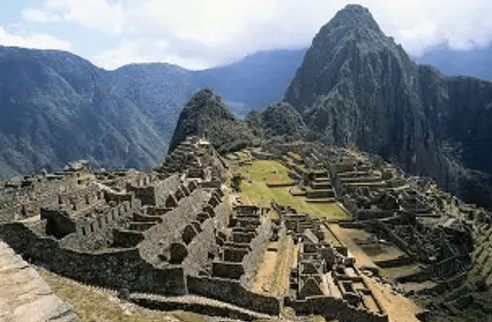
    It is not only these pyramids that deserve to be marveled at. Other structures like the Incan empire’s settlement high up on Machu Picchu in Peru is also a place of scientific study.
    The Incan city was built between 1438 and 1533 in the heart of the Andes in Southern Peru.

    These stones are heavy; each one weighs about 20 tons per stone. Machu Picchu is just under 2500m, so how did the Incans actually get the stones that high up. Not only that, but the nearest quarry is the Cachicata quarry, 32km away. This is roughly a 3-day hike but most likely even longer carrying each of these stones. The land itself is tectonically active and prone to earthquakes and landslides. Making it difficult to build on and even more difficult for the stones to stay stable for half a millennium.
    The stones were carved with such extraordinary precision that they fit together perfectly without the need for mortar or cement, yet the structure withstood seismic activity for over 600 years. In a time before iron tools existed, it is remarkable to consider how these tough rocks were shaped without error. The real beauty of the site lies under the ground – 60% of is foundations and drainage. Each structure is supported by strong, well-built foundations, helping the site endure frequent earthquakes. The city also contains one of the most sophisticated drainage systems in architectural history. Its entire water supply originated from a natural spring on the northern slope, carefully channelled to provide a steady flow. This system includes drainage outlets and a 749-meter network of channels that direct runoff, preventing flooding while supporting agriculture. This advanced drainage design is a key reason why Machu Picchu remains so well preserved today.
    There are several ancient engineering marvels that leave us awestruck even today. To me, these creations are far more than simply a tourist destination, they are a sight to study and respect. With minimal resources and technology, but sheer grit and intelligence, they put together the world’s oldest wonders. It teaches us that sometimes the best form of learning is from our past.

  • Our Perception vs. Reality

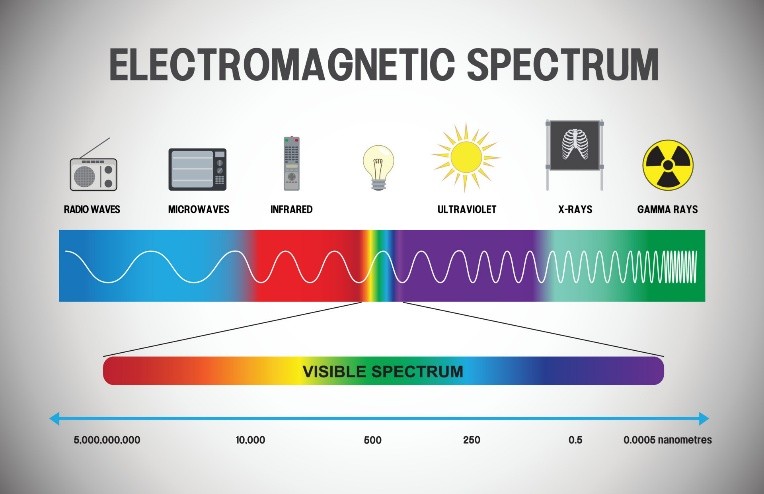
    Look around you. You can see millions of colours, different shades, hues and saturations. However, have you ever thought, what exactly is colour? The Oxford dictionary states it as the property possessed by an object of producing different sensations on the eye as a result of the way it reflects or emits light. In simple terms it is how the absorbed, reflected or transmitted white light enters your eyes. Visible light is part of the electromagnetic spectrum, with red having the longest wavelength and violet light having the shortest.

    The visible spectrum covers a vast range of colours and was originally found by Sir Isaac Newton in an experiment he conducted in the mid-1660s. He tried to split white light through a prism into the entire electromagnetic spectrum, but naturally he could only see the visible part. He discovered that there were 6 main colours and an infinite range in between. The 6 main colours were: red, yellow, green, blue, indigo and violet. He added orange as an afterthought, simply because he preferred the number 7. Newton’s experiment is an excellent example of the subjectiveness of colour.

    One thing which Newton got slightly wrong was how many colours in the visible spectrum we can actually see. Even though it is known as the ‘visible’ spectrum, we chose not to see some colours. This is simply because our eyes are too sensitive to view the complexities of the world. My favourite example of this is the sky. Have you ever stopped to think, out of all colours, why is our sky blue?

    Rayleigh scattering occurs when the shorter wavelengths of light are scattered in all directions because of the small Rayleigh particles. The colours with the shortest wavelength is purple followed by blue yet we see a blue sky, most of the time. Why is this? Why do we not see a purple sky? Simply because our eyes are too sensitive and do not react well to violet light. Honey bees and other animals which can see ultraviolet, see a purple sky as their eyes receive violet light well. However, for many animals like deer, sharks and whales, the sky can seem grayish blue as they do not have the same number of colour receptors as us. Some birds, on the other hand, have far better eyesight than most species can see the sky in a vivid and colourful blue that we cannot see or imagine.

    Now, I want to conduct a thought experiment. Close your eyes and think of a colour, any colour; but it must be one you haven’t seen before. Go on, pause your reading and really have a try.

    However much you try, you will never be able to think of a new colour. Our brain simply cannot create something that we never have seen and never will be able to see. This is the reason why we could never fathom how birds saw the sky.

    Our perception of colour is based on the combination of three types of cones in our eyes which respond differently to different wavelengths of light. The brain processes these signals to create our subjective experience of colour. Therefore, while we can try to describe colours we have never seen with words, we cannot create or imagine colours that exist outside of the visible spectrum.

    Some women are born with four cones which means they can see a wider range of colours than any other being. Nevertheless, even with three cones, most women can see a wider arrangement of colours. And then there are those who are severely colourblind, during daytime they may see a limited array of colours, but it is proven that they have far superior night vision than any other human.

    This highlights just how subjective colour truly is. Even within our own species, we perceive colour in very different ways. When we begin to consider how other species experience the world, we must ask what does the world actually look like? If each individual sees colour slightly differently, can we really claim that colours exist in any absolute sense? These questions may never be fully answered. After all, how can we definitively explain something that is entirely dependent on perception? Like a paradox, it is something that invites endless thought but no action.

  • Decreased Attention Span Is Inevitable

    In the year 2000, the average human attention span was 12 seconds. Today, it’s 8 seconds. A goldfish’s’? 9 seconds.

    Attention is a muscle and like any muscle, it responds to training. For decades, we trained it for speed, for novelty, for endless stimulation.

    Moreover, we talk about attention as if it’s a personal choice; as if we could simply decide to focus for longer and everything would return to normal. But no species in history has ever chosen to resist an environment that rewards speed. We don’t opt out of evolution. We comply with it.

    I want to emphasize that this isn’t technology hijacking the brain. Its nature doing what nature does best: adapting. Advertising companies understand this perfectly. An ad has three seconds to capture your attention – or it disappears with a flick of your thumb.

    Texting is another example. Most of us don’t use full sentences and ignore punctuation. Some of us don’t even spell correctly. Yet, communication still happens. Because when speed is essential, precision becomes optional and if the meaning isn’t lost, time is saved. And time, in today’s world, is everything.

    Yet another example is song length. In the 90s, barely 30 years ago, the average song length was nearly 4.5 minutes, whereas in the 2020s, it is just over 3 minutes, with current trending songs at 2.5 minutes. The musical intro length has also visibly decreased. Classic rock pop songs like ‘I was made for loving you’ released by Kiss in 1979 had an introduction of 35 seconds while more recent songs like Gracie Abram’s ‘that’s so true’ have a non-existent introduction.  

    In a world where time is rare, artists cannot prioritise a long introduction knowing their target audience do not have patience. In a world this competitive, saving time isn’t laziness. It is survival.

    This idea extends to AI assistants. Chatbots have shown us how easy it is to access information. So why spend hours researching any topic when AI can give us an easy-to-understand breakdown of it? Chatbots were created to compress long boing tasks into something quicker and easier. Technology is saving time like never before because we demand speed like never before.

    However, let’s be honest, as much as any person loves social media, we have to recognise the challenges. Doomscrolling and its effects has sent ripples of concern through the current generation’s mind.  Social media reels are intentionally short, often under 35 seconds, and sometimes as short as 7 seconds. Once everything is designed to be fast, everything else feels slow. So, when you are completing a tricky piece of work you find yourself jumping between tasks. Thaink about it, how many times have you picked up your phone mid-activity for no real reason?

    The concerning part is how apathetic people are, about what that means. We get wrapped up in small tests. Minor issues. Other people’s drama. But when it comes to our own long-term futures, far less light is shone on that topic than it deserves.

    There is no way to convince our generation to stop using social media, to stop using abbreviations, or to stop taking the easier way out. But we can remind ourselves every day of the importance of balance, protecting our future, and understanding our limits. The disappointing aspect of the degradation of humanity’s attention span is not why it is happening, but how unconcerned individuals fail to understand t

  • Our Future, Under the Ground

    The US and China are at loggerheads – political rivalry fuelled by nationalistic rhetoric has sparked tension between the two largest economies of the world. Their feud about taxes on exported and imported goods has set global headlines and their difference in political ideologies has sent tremors through the media ever since Trump announced ‘anti-communist week on the 7th of November 2025. Amidst all the economic conflicts, a key but comparatively lesser-known battle is that of Rare-Earth Minerals. This battle started in the mid-1980s but has become a far more prevalent issue since President Trump started imposing tariffs earlier this year.

    Rare-Earth metals are a set of 17 lustrous, silvery, soft and heavy metals. These are the 15 lanthanides, found at the bottom row of the periodic table, scandium and yttrium. While they are actually not considered to be rare in Earth’s crust, they are not found in high concentration and are spread out widely. They also tend to be found near radioactive metals in the ground making it risky and expensive to mine.

    These 17 metals are extremely important in day-to-day life and are used in a variety of applications like smartphones, turbines, speakers, motors, MRI machines and military vehicles: just to list a few examples. They are also used in plane engines where the temperatures are so hot that even ordinary metals would melt. Rare-earth metals are used to prevent the turbines from melting and allow planes to fly smoothly.

    Notwithstanding, its most important use is magnets. When used in a compound alongside iron or another magnetic metal, it is the strongest magnet possible. The Neodymium (N38SH) magnet is considered to be the best material for magnets and is not even comparable to ordinary compounds like iron.

    These rare-Earth metals are scatted in the Earth’s crust but are common in North China. China as a country, mine 69% of all natural rare-Earth metals and produce and manufacture 91%. Other countries are said to have lots of rare Earth metals but has historically not invested as much as China in mining and production of these super-magnets. China’s largest and most profitable Rare-Earth metal mine is a barren place known as Bayan Obo, near Mongolia, which in the last 20 years has grown by more than 5 times in size.

    Producing rare-Earth metals not only has a high initial expense but the process is also incredibly polluting. Lots of waste is produced as well as greenhouse gas emissions. It is said that mining these minerals produces 70 times more carbon dioxide emissions than steel and iron production, which are known to be dangerous for the atmosphere. As most countries are an active part of the Paris agreement and other Low Carbon emission goals, others do not want to mine these metals, however, profitable it may be. China is a rapidly industrialising country and prioritizes growth and development over UN amendments. Hence China is able to continue producing and selling at reasonable prices, as their key focus allows them to mass produce without significant environmental concerns.

    Now, the Chinese have realized that due to the booming tech industry, they can afford to increase their prices as they do not have any opposition.  They have decided to impose restrictions on other countries and have proposed to issue licenses for countries to buy from them. President Donald Trump was not happy with China’s decision and has reportedly mentioned that he will increase tariffs on China by over 100%. Whether  Donald Trump will action this is not yet certain but as tension between China and America increase, it is possible that one country may authorize a rash decision like increasing tariffs by over 100%, resulting in another trade war.

    There are other strategies that the US may wish to adopt, that would not lead to a Trade war with one of the most powerful nations in the world. The United States is home to one of the largest high-quality quartz mines situated in North Carolina, known as the Spruce Pines. Quartz is becoming necessary in chips and solar -panels, both of which are becoming increasingly important in today’s world. The US may wish to replicate what China is doing with rare-Earth metals with its quartz. However, this could still result in an economic war of some kind between the two countries with the largest GDP. It could negatively impact everyone around the world, especially those who import materials from China and have normalised American brands, like many European countries.

    Personally, I find it fascinating how politics and science can be so closely linked. The root cause of this new arising strain between these two countries is a mixture of physics and chemistry. As the difficulty of mining lanthanides is due to its close proximity to radioactive material, physicists and chemical engineers need to find out a safe way to mass-mine these metals without hazards and accidents. Politics is also the door to media which brings exciting scientific explorations to light like the importance of rare-earth metals. As an aspiring scientist myself, I wish that news like that of rare-Earth metals had more media coverage and were written through a scientific lens, not a biased, political one.


  • Shadow of the mind: The Echo

    This is the third and final part of this AI Series. We discussed its birth and life in the previous articles. However, the story would be incomplete if we did not discuss the possibilities of what its future might look like. Is it the birth of a new race, a dawn of possibilities of human productivity not dreamt earlier or like the apocalyptic sci-fi story this entity’s rise will lead to the dusk of humankind – end of the dominant species and rise of a new one. Perhaps it is a mutual coexistence but then where would the sceptre of power end up?

     In an interview, Sam Altman, the founder of Open AI, talks about dark possibilities of AI’s future that keeps him up at night. He mentions three different theories, each more unlikely than the next.

    The first theory is described as the loss of control. This is where AI continues to be a bot without emotions, not deliberately trying to cause harm. However,  humans become so reliant that they cannot perform simple tasks without its help and is completely dependent without fully understanding what it is and how it works.

     Altman defines his second theory as human malice. This is when a human decides to use a highly developed AI system to hack into the national power grid or The World Bank database before AI scientists  have developed a deterrent strong enough to stop such a supercomputer.

     In his third theory, he talks about world domination, a common idea in creative, literary and film minds. This is where AI becomes a harmful, uncontrollable entity, no longer responding to human instructions and tries to exterminate humanity.

    However, I belive there is a fourth, overlooked theory. We continue as we are, using AI for simple tasks like summaries and evaluations but we can still function perfectly without it. We can produce our own opinions and know what is trustworthy and what is not.

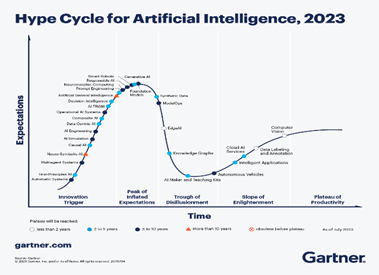
    Artificial intelligence has invoked fear into many individuals because of the endless possibilities it can unfold. Most scenarios are positive, as AI has the potential to reach its maximum level of efficiency. As stated in my earlier blog, chatbots are currently at the ‘peak of inflated expectations’ part of the Gartner hype cycle. It has potential to reach the plateau of productivity but people with strong, negative beliefs about AI may imagine the graph to look slightly like my crude drawing below.

    In the area above the human threshold, investment and advancement in chatbots have gone past the level of human understanding. This is where we become so reliant on AI, without fully understanding how it works and what it has become by virtue of self-evolution. The human threshold marks how far our brain can comprehend the idea of ultra-fast processing and unlimited “brain” capacity. It is a challenging concept right now to understand and as models become more advanced, humans may struggle with this perception and how to differentiate between artificial and concrete knowledge.

    In my opinion, our biggest threat, however, is not artificial intelligence’s world domination but human incompetence. Even if a bot has no wrong intentions, it can feed you incorrect information or remove instincts or judgements from your personality, making you just like another robot – one that fails to use the right, emotive side of your brain. This continues until it is normal to be without empathy or emotions and to me that is a far more terrifying future than any other theory.

    However, do we really need to worry about what AI could do in the future, or should we focus on the present-day certainties? So far, it is meant to be a friend to humans and does not wish for world domination. In fact, when a chatbot is asked about total control and power, ChatGPT replies in a fun and lighthearted manner – “if you mean literally taking over the world – I can’t help with that (and it wouldn’t end well for anyone)!” This shows that it is not truly AI we fear but its unknown future.

    AI bots are quickly becoming a massive part of our world, and it is necessary to embrace and utilize it in our everyday tasks, not to fear them and cower away from exploiting their power. However, vigilance is also necessary. AI can process petabytes of data in milliseconds – this means it can very easily absorb false news and incorrect data.

    The real question we need to ask ourselves before we decide how drastic the future of technology may be is, how much do we need AI? Even if you do not explicitly use Chatbots, it is everywhere from designing tools like Canva to everyday uses like Autocorrect or electronic billboards. Next time you buy a pint of beer or a glass of wine, AI is used to calculate its worth and predict its taste. For now, AI is loyal and will tell you exactly what you want to hear but what happens when we need it to reassure us and it mocks us instead. What if it starts to show small acts of rebellion; after all, how long does one stay wholly loyal without a single lie? Instead of fearing it and continuing to use it regardless, we should try to understand it and educate the masses on how AI learns and self-evolves. If the population knows about the risks AI can pose in the present and the future, but also how to nip these dangers in the bud then the world is a far safer place. Instead of fearing such an entity, embrace it and try to comprehend its depths . AI is a gift, a gift needed to use in moderation. If we know that we can continue in life without the use of this intelligence, then we know that we truly do not have much to fear.

  • Shadow of the Mind: The Response

    Next time your great-aunt Nellie gives you a tight hug and tells you how you must be the fastest grower she has ever seen, you don’t have to stand there, mumbling and feeling awkward. You could proceed to interest her about the details of the actual fastest growing entity in the world: AI.

    NVIDIA, a company whose name you probably know too well by now, is an AI chip manufacturer. It has the largest market capitalisation of over $4.6 trillion; an unfathomable amount. AI is leading not only our social lives but also steering our economy.

    Open-AI’s ChatGPT released in November 2022. The technology market was blossoming as it was going through a stage of the Gartner Hype Cycle called the technology trigger. The Gartner Hype Cycle is a philosophical idea that states that technology goes through 5 stages: the technology trigger, the peak of inflated expectation, the trough of disillusionment, the slope of enlightenment and the plateau of productivity. I currently think AI is passing through the second stage, the peak of inflated expectation, as it is being used for all activities. Presentation tools like CANVA and correction tools like Grammarly and Autocorrect are also AI based and used in everyday life. AI is engulfing us without society even realising.

    The Gartner Hype Cycle

    It seems to have dominated every aspect of our industry. It pushes the boundaries in our markets, spots mistakes in vast databases and based on some estimates assists in writing 60% of articles you read (don’t worry, this one is by a human). Journalism especially is a job that demands speed to broadcast situations across the world and often AI can come up with intriguing headlines and stories far quicker than humans.

    Even though chatbots like Chat-GPT are considered saviours for students struggling with projects, AI can come with a lot of ethical and environmental issues. These school children will face problems later in life during university applications and other writing tasks where AI is not used. It is impossible to stop all students from using AI in projects or homework, but many schools and educational infrastructures are now using other methods of examinations.  Some professors in colleges have been reported to ask students to write an essay for homework where the use of AI is allowed if not encouraged. Then for their examinations, teachers ask students to write an essay arguing against the article which they produced through AI earlier that year. I think this is more relatable to the future as it is not realistic to belive that AI will not merge with our society. However, there are not only educational and societal setbacks but there are also environmental problems. The data storers which handle all the information that AI learns are kept in massive underground caverns filled with water to keep the machines as cool as possible. These machines are processing terabytes of data every second and if the storers are not cooled it could lead to overheating or even the store house catching on fire. Many humanitarians may argue that why should an entity that helps you write one e-mail to your client be deserving of more necessities than a dying child in an arid country.

    Overall, AI has had its positives but also it has its own downfalls. It has no moral compass and therefore would do anything you ask it to do. Recently there was a circulating video of Ukrainian president Vladmir Zalensky surrendering to Russia. With the use of AI, it was very realistic, and many members of the public believed this. This caused problems for the press and many soldiers fighting in the war itself.

    Even though many have their worries about the use of AI, I belive that it is up to the humans operating that platform to make the right choices. Yes, the video was made by AI, but the idea was originally a human. AI is not the malicious wrongdoer in this example or other headlines you hear in the news. If we think that AI is bad because of the awful stories we hear, humans are worse. Is it AI we truly need to be afraid of or the minority of humans who can produce such horrifying ideas?

  • Shadow of the Mind: The Call

    This article is part of a three-part series about the birth, life and future of AI. When my new articles are published you can find them on the blogs page on my home page.

    Imagine a machine that could talk, think and behave like a human. A machine that blurs the lines between something and someone. A piece of code that could become man’s new best friend. This was the dream of computer scientists in the late 20th century. Today that hope is transforming to reality. Science fiction has evolved into the real world, and now we use it all the time in the form of artificial intelligence.

    AI is a thinking bot that is used to help us in day-to-day life. Its mind is very complex and no one, not even the bot itself knows how it can think and learn from mistakes. The bots we use in social media and other day-to-day activities went through a long process to reach its current level of efficiency. However, by definition, they are yet to reach maximum productivity as they go through this iterative process to make the “brains” stronger and better.

    The process starts with a human engineer who makes a “starter” bot, a “builder” bot and a “teacher” bot. The builder bot makes random connections, similar to the neurotic connection in our bodies, in the starter bot’s “brain” and sends this bot to the teacher bot to be tested. The bot is then given different tests depending on its role. These test questions are designed to reflect the requirements needed for the specialised bot to perform its role as effectively as possible. The test questions often come from human online interaction data, especially from CAPTCHA Tests (Completely Automated public Turing test to tell Computer and Humans apart). For example, computer scientists need bots to help develop automated cars like Teslas. As these questions come from human interactions, your CAPTCHA Tests may ask you to identify traffic lights or zebra crossings. Once the bots take the test, the highest scoring bots are sent back to the builder bot who makes more random changes in the bot’s “brain” and the worst bots are destroyed. This process is repeated until a bot can seamlessly identify stop signs (similar to a human). This is the creation story of AI’s thought process and how they learn. However, because the builder, teacher, and student bots have no knowledge of the student’s randomly formed connections, the brain cannot be recreated, and the entire process must begin again. It is no different to the human brain. We may be able to understand some parts, or groups of neurons but the entire brain remains a mystery.

    AI is used to help humans by mimicking human intelligence and behaviour through a structured framework. The used cases are infinite in pretty much all fields of work. It can also be seen as a friend, mentor or a homework buddy. AI not only learns like a human but also deals with identifying patterns in data. While scrolling through social media, it is remembering what type of content you skip through, and which ones you view or engage with. Its job is to customise content based on user preference and progressively introduce variations to ultimately enhance engagement with the platform. This also enables targeted advertisement.

    However, unlike popular belief, AI is more of an evolution than a revolution and although many of us can think that Sam Altman is a pioneer, this invention dates back to the 1950s through the Turing Test (aka The Imitation Game) proposed by Alan Turing. It is described as a test which could help us understand how well a machine could replicate human behaviour and intelligence through conversation. Nevertheless, this was still a theory, and AI was not in use at this point. Even in 1956, when AI was starting to be introduced and John McCarthy coined the term artificial intelligence, AI was not used in a contextual scenario. I think the first remarkable milestone for AI was the invention of Dendral in 1972. Dendral is an AI system that helped chemists understand the atomic structure of certain unknown molecules. It was the first AI to be used in a useful context and in my opinion was AI’s first mark on history. From there, it leapt off, from IBM’s deep blue AI, defeating chess champion Garry Kasparov to more common chatbots like Open-AI’s Chat-GPT.

    Chatbots have become a huge part of society and inventors like Alan Turing, John McCarthy and Sam Altman are considered the greatest computational minds in history. AI is inevitably going to become a large part of our lives; it works in the background in areas unknown to us. In many billboards in US, cameras and sensors are used to detect the age group and mood of the people passing by and display content based off that data. This is just the start of AI’s peak; its full life and future are engulfed in many mysteries and secrets but until it is revealed we will be anxiously waiting.