Tag: peru

  • Peru: An Unforgettable Destination

    Recently, I visited Peru for a once in a lifetime experience. Travelling all the way to South America was a true novelty for me that I do not think will wear off anytime soon. A one-of-a-kind trip like this needed a blog of its own especially as lots of lessons I learnt applies to everyone on a shockingly large scale.

    After an exhausting 35-hour journey, we finally arrived at our hotel in Puno, a small town right next to Lake Titicaca, the highest navigable lake in the world. My first thought when I think of our premier night there is how we greatly underestimated the altitude. We left London thinking an altitude of 3900m was easily manageable.  We were pretty unperturbed until it came to sleeping. I had never had a worse night of sleep. Even while sleeping I could feel a pounding in my head – a headache that could rival Zeus’s. My family and I had to wake up in the middle of the night and take emergency altitude sickness tablets before our breathing became more regulated and the pounding became a dull throb.

    After this oxygen deprived land our bodies were in for a stark contrast, as we headed to the lungs of Earth, the Peruvian Amazon Rainforest. Here we went kayaking down the Madre Di Dios River, an endless river that feeds into the Amazon.

    We also went for long walks into the jungle during the daytime as well as a thrilling night expedition. We observed a stunning array of land, river, and lake animals, including cute furry creatures like sloths and spider monkeys as well as more fearsome creatures like the large black caiman and pink-toed tarantula. Riding upstream to see clay licking of Macau and being five times lucky in sustainable piranha fishing will remain etched in my memory for a very long time.  It was amazing seeing rare animals that you could never see in England, in their natural habitats. We were sad to say goodbye to Puerto Maldonado and our amazing guide but excited for our adventure starting in Cuzco, where we would start the famous Inca trail.

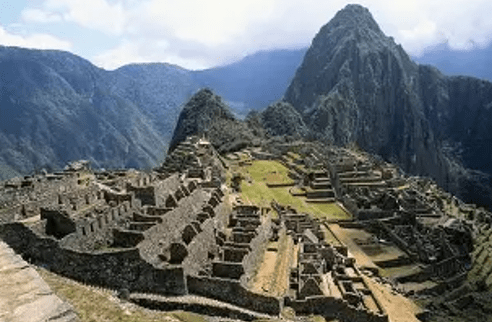
    When we arrived in Cuzco, we had a few days to acclimatise again and enjoy the picturesque city and nearby historic Inca sites. The next day we were hit with devastating news by our travel agent. Due to heavy rain, the campsites of our much awaited 4-day hike on the Classic Inca train to Machu Pichu were completely flooded and unusable in spite of the government’s efforts to fix it as quickly as possible. Not one to give up easily, after much deliberation, we ended up with a bespoke trail – choosing the more challenging, the Salkantay trail followed by 2 days hike on the classic trail to Machu Pichu.
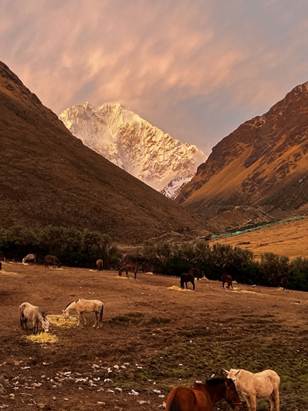
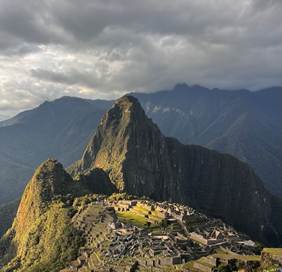
    The Salkantay trail’s second day was by far the most gruelling, a 22km hike at 4,650m altitude was no laughing matter. The group even had emergency horses in case any of us became physically exerted. Thankfully, we did not need it and felt an overwhelming amount of accomplishment as we reached our campsite for the night. When we arrived at Macchu Picchu at the end of our long journey through different terrains (alpine tundra, mountains and rainforest), we were tired but also swept away at the sight of such a marvel. We learnt that it was untouched until 1911 when an American explorer, Hiram Bingham III discovered it after gathering information from indigenous locals. Conservation to restore such a historic wonder was continued until it was declared a UNESCO world heritage site in 1984. Now the only protectors are the llamas wondering around the Incas’ greatest wonder. Before we left on this trip, I wrote a blog about the theory behind their spectacular architecture but to see it in person was surreal.
    Upon our return we learnt that the untimely rain followed by flooding could have been caused by the El Nino effect. This happens when the surface temperature of the Equatorial Pacific Ocean rises at least 0.5 degrees Celsius above normal for several months. This warming weakens or reverses the usual East-to-West trade winds, allowing warm water to move Eastward towards South America, especially Ecuador and Peru. This causes heavy flooding in South America and can lead to dry conditions in countries like the UK (which explains the multiple heat waves we have had here this summer).

    Amidst the trip, also came the devastating news of the Nepal flood. A large section of a glacier – the size of 9 football pitches, near Langtang Lirung collapsed, falling approximately 1,200 meters into the valley below. This glacier collapse generated a massive ice-rock avalanche, which melted rapidly due to friction and impact, producing a sudden surge of water. This water then flowed into the river, where mud from the collapse had already formed a natural dam. The build-up of water caused the dam to break, along with many people’s livelihoods. (If you wish to help out, I am raising money for this cause on my home page so please donate.)

    A trip this special made me a storyteller amongst my friends as I told them the stories of my thrilling holidays. All of my friends ask me the same questions, was all those 4am wake ups and long journeys worth it, and my answer any day, every day would be an emphatic yes, most definitely yes!

    (All photos taken by me)
  • Wonders of our Past

    As a Londoner, I often find myself comparing the regal Victorian architecture in places like Bank and Regent Street to the high-rise modern apartments in Southwark and Canary Wharf. The beauty of the regency architecture is unparallel as it brings a sense of class and grandeur. In contrast, the modern skyline is functional with its ergonomical design. No points for guessing my favourite form – keeping the classical architecture but adding the necessary modern twists (like insulated walls and draft management). However, thinking about architectural science, there is little comparison of the wonders created thousands of years ago. When compared, one could argue that the application of geometry and its execution may not have attained the same level of precision as witnessed 4000 years ago.


    Take the pyramids of Giza. It is common knowledge that the stones used were enormous and weighed around 15 tons each. Without modern cranes, transporting these boulders is a massive feat in itself. However, it is only when we look closer that we can truly marvel at the oldest wonder of the world. If one took the slanting height of the pyramid and divided it by half of the length of the base, you get a number suspiciously close to the golden ratio (about 1.68). To highlight the magnitude of this discovery, the golden ratio (phi) was only discovered by the Greeks 2000 years later. It creates a mathematically perfect monument with visually appealing proportion. It also has close links to the Fibonacci sequence as the ratio of consecutive Fibonacci numbers converges towards phi. This shows that a complex level of geometry was perhaps subconsciously, perhaps purposefully applied in building these towering sculptures.


    Another Greek mathematical term that everyone is familiar with is pi. Founded in 250 BCE, it has been integrated in our society for just under 3000 years. But when the Egyptian slaves were building these pyramids in 2500 BCE, how did they know about this theory? The (perimeter of base)/(2*height) is almost exactly equal to pi for every pyramid. So, how was this possible? Was it an understanding of complex geometry or a simple coincidence? One may belive it is the latter, but when we discover some more of the pyramid’s hidden features we may think differently.


    The four points on the base of the pyramid are aligned to the True North, South, East and West. The True North is different to the magnetic North which changes. A standard compass only shows you the magnetic North so in a world without GPS you would need to rely on tracking the shadow of the sun during spring and autumn equinoxes. This is when the Sun is directly above the equator and the day and night are equal. The Autumn equinox illuminates a path from the East to the true West which can be traced and eventually points out the True East and West.

    The base itself perfectly matches the curvature of the Earth, making it pretty straight for a monument without blueprints, floorplans or drone technology. Each side has an average error of only 58mm. In a monument this big and in a civilization without basic measurement tools, this fine error margin is remarkable.
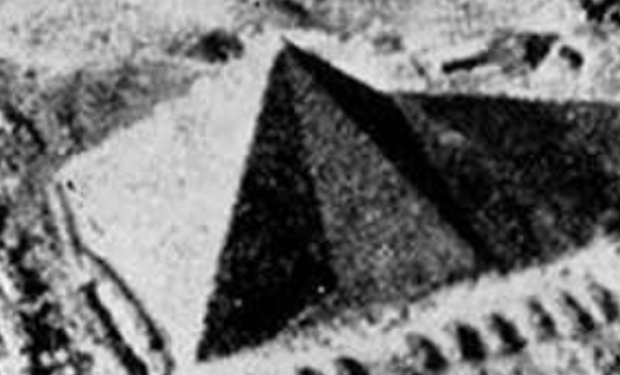
    Another wonder is the concaveness of each side of the pyramid. It is known as the only 8-sided pyramid in the world. As it is consistent on all four sides and all three pyramids, it can be assumed that this design was intentional. Not only is the architecture of this extremely difficult but the subtlety of it is worthy of study. It is only visible under certain lighting like the spring and autumn equinox. The sun casts a shadow that splits each face into light and dark halves. This adds to the idea that the design was linked to solar symbolism and astronomical observations.

    It is not only these pyramids that deserve to be marveled at. Other structures like the Incan empire’s settlement high up on Machu Picchu in Peru is also a place of scientific study.
    The Incan city was built between 1438 and 1533 in the heart of the Andes in Southern Peru.

    These stones are heavy; each one weighs about 20 tons per stone. Machu Picchu is just under 2500m, so how did the Incans actually get the stones that high up. Not only that, but the nearest quarry is the Cachicata quarry, 32km away. This is roughly a 3-day hike but most likely even longer carrying each of these stones. The land itself is tectonically active and prone to earthquakes and landslides. Making it difficult to build on and even more difficult for the stones to stay stable for half a millennium.
    The stones were carved with such extraordinary precision that they fit together perfectly without the need for mortar or cement, yet the structure withstood seismic activity for over 600 years. In a time before iron tools existed, it is remarkable to consider how these tough rocks were shaped without error. The real beauty of the site lies under the ground – 60% of is foundations and drainage. Each structure is supported by strong, well-built foundations, helping the site endure frequent earthquakes. The city also contains one of the most sophisticated drainage systems in architectural history. Its entire water supply originated from a natural spring on the northern slope, carefully channelled to provide a steady flow. This system includes drainage outlets and a 749-meter network of channels that direct runoff, preventing flooding while supporting agriculture. This advanced drainage design is a key reason why Machu Picchu remains so well preserved today.
    There are several ancient engineering marvels that leave us awestruck even today. To me, these creations are far more than simply a tourist destination, they are a sight to study and respect. With minimal resources and technology, but sheer grit and intelligence, they put together the world’s oldest wonders. It teaches us that sometimes the best form of learning is from our past.