Tag: neurology

  • Shadow of the Mind: The Call

    This article is part of a three-part series about the birth, life and future of AI. When my new articles are published you can find them on the blogs page on my home page.

    Imagine a machine that could talk, think and behave like a human. A machine that blurs the lines between something and someone. A piece of code that could become man’s new best friend. This was the dream of computer scientists in the late 20th century. Today that hope is transforming to reality. Science fiction has evolved into the real world, and now we use it all the time in the form of artificial intelligence.

    AI is a thinking bot that is used to help us in day-to-day life. Its mind is very complex and no one, not even the bot itself knows how it can think and learn from mistakes. The bots we use in social media and other day-to-day activities went through a long process to reach its current level of efficiency. However, by definition, they are yet to reach maximum productivity as they go through this iterative process to make the “brains” stronger and better.

    The process starts with a human engineer who makes a “starter” bot, a “builder” bot and a “teacher” bot. The builder bot makes random connections, similar to the neurotic connection in our bodies, in the starter bot’s “brain” and sends this bot to the teacher bot to be tested. The bot is then given different tests depending on its role. These test questions are designed to reflect the requirements needed for the specialised bot to perform its role as effectively as possible. The test questions often come from human online interaction data, especially from CAPTCHA Tests (Completely Automated public Turing test to tell Computer and Humans apart). For example, computer scientists need bots to help develop automated cars like Teslas. As these questions come from human interactions, your CAPTCHA Tests may ask you to identify traffic lights or zebra crossings. Once the bots take the test, the highest scoring bots are sent back to the builder bot who makes more random changes in the bot’s “brain” and the worst bots are destroyed. This process is repeated until a bot can seamlessly identify stop signs (similar to a human). This is the creation story of AI’s thought process and how they learn. However, because the builder, teacher, and student bots have no knowledge of the student’s randomly formed connections, the brain cannot be recreated, and the entire process must begin again. It is no different to the human brain. We may be able to understand some parts, or groups of neurons but the entire brain remains a mystery.

    AI is used to help humans by mimicking human intelligence and behaviour through a structured framework. The used cases are infinite in pretty much all fields of work. It can also be seen as a friend, mentor or a homework buddy. AI not only learns like a human but also deals with identifying patterns in data. While scrolling through social media, it is remembering what type of content you skip through, and which ones you view or engage with. Its job is to customise content based on user preference and progressively introduce variations to ultimately enhance engagement with the platform. This also enables targeted advertisement.

    However, unlike popular belief, AI is more of an evolution than a revolution and although many of us can think that Sam Altman is a pioneer, this invention dates back to the 1950s through the Turing Test (aka The Imitation Game) proposed by Alan Turing. It is described as a test which could help us understand how well a machine could replicate human behaviour and intelligence through conversation. Nevertheless, this was still a theory, and AI was not in use at this point. Even in 1956, when AI was starting to be introduced and John McCarthy coined the term artificial intelligence, AI was not used in a contextual scenario. I think the first remarkable milestone for AI was the invention of Dendral in 1972. Dendral is an AI system that helped chemists understand the atomic structure of certain unknown molecules. It was the first AI to be used in a useful context and in my opinion was AI’s first mark on history. From there, it leapt off, from IBM’s deep blue AI, defeating chess champion Garry Kasparov to more common chatbots like Open-AI’s Chat-GPT.

    Chatbots have become a huge part of society and inventors like Alan Turing, John McCarthy and Sam Altman are considered the greatest computational minds in history. AI is inevitably going to become a large part of our lives; it works in the background in areas unknown to us. In many billboards in US, cameras and sensors are used to detect the age group and mood of the people passing by and display content based off that data. This is just the start of AI’s peak; its full life and future are engulfed in many mysteries and secrets but until it is revealed we will be anxiously waiting.

  • The Illusions of the Brain

    Humans have a natural tendency to assume and judge their surroundings based on past knowledge and experience. We want a solution that is quick and easy, that doesn’t require us to stress or push the mind. Humans in general are lazy beings, and we are comfortable living in this realm of illusions. The world provides us with twists and turns, colours and hues for us to enjoy but our perception is deterred by the rules that society creates.

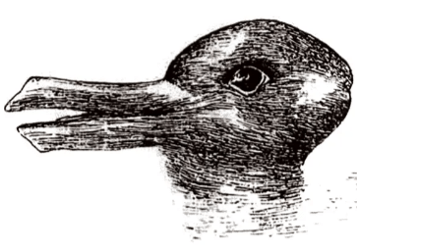
     For example, in this drawing, what do you see, a duck or a rabbit? If you tilt your head to one angle you may see a duck’s beak on the left but if you look at it from a different angle you see the rabbit’s ears to the left. However, no one will ever be able to see both at the same time, some people even struggle to see both at different times. This reflects the openness of your mind. Humans often need additional context or information to be able to identify objects in our world. Now, if I told you that this was drawn near a pond, then you would think that it was safe to presume this was meant to be a duck. With just one sentence, I could change your viewpoints and therefore your understanding of the world around you. Your perception is built on information gathered from a young age and the rules of society. You (and majority of others) would expect a duck to be by a pond, rather than a rabbit, hence your brain believes that this drawing being a duck is a more likely option.

    At birth, there is a very limited number of things you can do without being taught. Firstly, when you are born, you only have two fears, loud noises and separation from your parents. More common fears like spiders, the dark, or the supernatural are influenced by the world around you. Society around you shapes your understanding of the world. For example, the concept of ghost being unhinged spirits with a thirst for blood was introduced through horror movies. Due to this many parents would not have allowed their children to watch such movies due to the fear factor. However, not watching horrors have left children in fear of “the monster” under their bed, a fear which is more comparable to the fear or the unknown.

    Secondly, as babies have not yet been taught how to walk, stand sit or run, most think there are very few movements that babies can do. Actually, you would be surprised. Form birth babies’ brain dictates thousands of commands per second. Involuntary movements like blinking, breathing and pain recognition are abilities that we are born with. Other movements are learnt from society, just like your fears, inhibitions and definition of success.

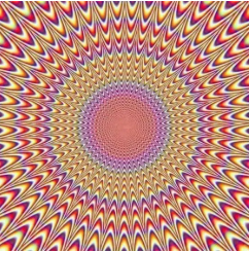
    We have gotten so used to these involuntary actions that sometimes we forget the importance and the hinderances of these movements. For example, blinking stops your eyes drying up, gives a constant flow of oxygen to the cornea and protects the eyes from dust and tiny debris. If you didn’t blink you would face eye strain and pain for the first few minutes and then this will eventually lead to blindness. It seems sane to give up 0.33 seconds to avoid potential blindness. However, this is actually a long time; in the time it takes for us to blink light can travel 90,000 kilometres. Blinking can hinder your ability to see the full picture. In the image below the circles look like they are pulsing because your brain cannot comprehend the variety of different shapes and colours while blinking.

    Which is why even if you can physically see, feel and sense the object in front of you, you might not want to trust everything that your brain perceives. The human brain’s complexity can be its downfall. Trusting the image that your brain creates can lead to your greatest mistakes. This doesn’t have to relate to just some optical illusions but to the bigger picture; how you perceive different people and therefore how you act around them. You will only truly experience the world if you keep an open mind, because even when you think you have learnt all the tricks to life, and the next one will surprise you.