Should you choose to believe everything?
Humans have a natural tendency to assume and judge their surroundings based on past knowledge and experience. We want a solution that is quick and easy, that doesn’t require us to stress or push the mind. Humans in general are lazy beings, and we are comfortable living in this realm of illusions. The world provides us with twists and turns, colours and hues for us to enjoy but our perception is deterred by the rules that society creates.
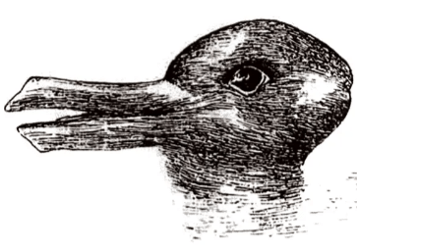
For example, in this drawing, what do you see, a duck or a rabbit? If you tilt your head to one angle you may see a duck’s beak on the left but if you look at it from a different angle you see the rabbit’s ears to the left. However, no one will ever be able to see both at the same time, some people even struggle to see both at different times. This reflects the openness of your mind. Humans often need additional context or information to be able to identify objects in our world. Now, if I told you that this was drawn near a pond, then you would think that it was safe to presume this was meant to be a duck. With just one sentence, I could change your viewpoints and therefore your understanding of the world around you. Your perception is built on information gathered from a young age and the rules of society. You (and majority of others) would expect a duck to be by a pond, rather than a rabbit, hence your brain believes that this drawing being a duck is a more likely option.
At birth, there is a very limited number of things you can do without being taught. Firstly, when you are born, you only have two fears, loud noises and separation from your parents. More common fears like spiders, the dark, or the supernatural are influenced by the world around you. Society around you shapes your understanding of the world. For example, the concept of ghost being unhinged spirits with a thirst for blood was introduced through horror movies. Due to this many parents would not have allowed their children to watch such movies due to the fear factor. However, not watching horrors have left children in fear of “the monster” under their bed, a fear which is more comparable to the fear or the unknown.
Secondly, as babies have not yet been taught how to walk, stand sit or run, most think there are very few movements that babies can do. Actually, you would be surprised. Form birth babies’ brain dictates thousands of commands per second. Involuntary movements like blinking, breathing and pain recognition are abilities that we are born with. Other movements are learnt from society, just like your fears, inhibitions and definition of success.
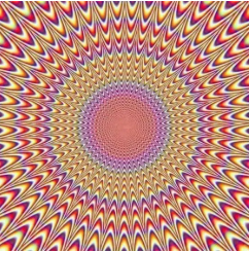
We have gotten so used to these involuntary actions that sometimes we forget the importance and the hinderances of these movements. For example, blinking stops your eyes drying up, gives a constant flow of oxygen to the cornea and protects the eyes from dust and tiny debris. If you didn’t blink you would face eye strain and pain for the first few minutes and then this will eventually lead to blindness. It seems sane to give up 0.33 seconds to avoid potential blindness. However, this is actually a long time; in the time it takes for us to blink light can travel 90,000 kilometres. Blinking can hinder your ability to see the full picture. In the image below the circles look like they are pulsing because your brain cannot comprehend the variety of different shapes and colours while blinking.
Which is why even if you can physically see, feel and sense the object in front of you, you might not want to trust everything that your brain perceives. The human brain’s complexity can be its downfall. Trusting the image that your brain creates can lead to your greatest mistakes. This doesn’t have to relate to just some optical illusions but to the bigger picture; how you perceive different people and therefore how you act around them. You will only truly experience the world if you keep an open mind, because even when you think you have learnt all the tricks to life, and the next one will surprise you.
 Everyone Wants to Know