Look around you. You can see millions of colours, different shades, hues and saturations. However, have you ever thought, what exactly is colour? The Oxford dictionary states it as the property possessed by an object of producing different sensations on the eye as a result of the way it reflects or emits light. In simple terms it is how the absorbed, reflected or transmitted white light enters your eyes. Visible light is part of the electromagnetic spectrum, with red having the longest wavelength and violet light having the shortest.
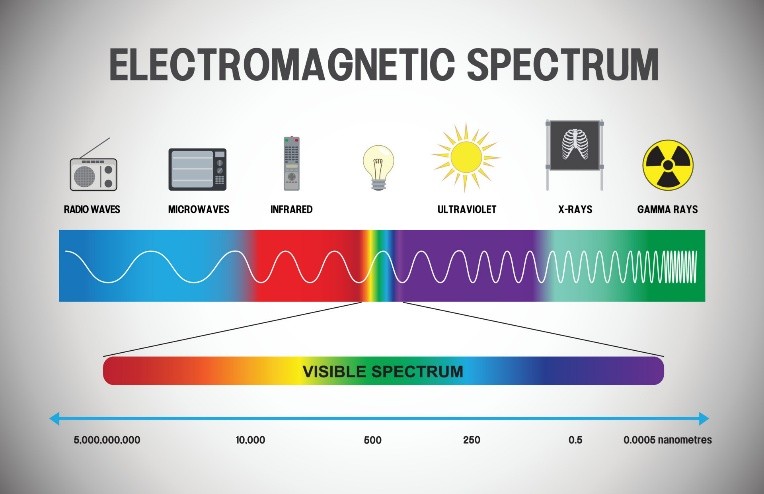
The visible spectrum covers a vast range of colours and was originally found by Sir Isaac Newton in an experiment he conducted in the mid-1660s. He tried to split white light through a prism into the entire electromagnetic spectrum, but naturally he could only see the visible part. He discovered that there were 6 main colours and an infinite range in between. The 6 main colours were: red, yellow, green, blue, indigo and violet. He added orange as an afterthought, simply because he preferred the number 7. Newton’s experiment is an excellent example of the subjectiveness of colour.
One thing which Newton got slightly wrong was how many colours in the visible spectrum we can actually see. Even though it is known as the ‘visible’ spectrum, we chose not to see some colours. This is simply because our eyes are too sensitive to view the complexities of the world. My favourite example of this is the sky. Have you ever stopped to think, out of all colours, why is our sky blue?
Rayleigh scattering occurs when the shorter wavelengths of light are scattered in all directions because of the small Rayleigh particles. The colours with the shortest wavelength is purple followed by blue yet we see a blue sky, most of the time. Why is this? Why do we not see a purple sky? Simply because our eyes are too sensitive and do not react well to violet light. Honey bees and other animals which can see ultraviolet, see a purple sky as their eyes receive violet light well. However, for many animals like deer, sharks and whales, the sky can seem grayish blue as they do not have the same number of colour receptors as us. Some birds, on the other hand, have far better eyesight than most species can see the sky in a vivid and colourful blue that we cannot see or imagine.
Now, I want to conduct a thought experiment. Close your eyes and think of a colour, any colour; but it must be one you haven’t seen before. Go on, pause your reading and really have a try.
However much you try, you will never be able to think of a new colour. Our brain simply cannot create something that we never have seen and never will be able to see. This is the reason why we could never fathom how birds saw the sky.
Our perception of colour is based on the combination of three types of cones in our eyes which respond differently to different wavelengths of light. The brain processes these signals to create our subjective experience of colour. Therefore, while we can try to describe colours we have never seen with words, we cannot create or imagine colours that exist outside of the visible spectrum.
Some women are born with four cones which means they can see a wider range of colours than any other being. Nevertheless, even with three cones, most women can see a wider arrangement of colours. And then there are those who are severely colourblind, during daytime they may see a limited array of colours, but it is proven that they have far superior night vision than any other human.
This highlights just how subjective colour truly is. Even within our own species, we perceive colour in very different ways. When we begin to consider how other species experience the world, we must ask what does the world actually look like? If each individual sees colour slightly differently, can we really claim that colours exist in any absolute sense? These questions may never be fully answered. After all, how can we definitively explain something that is entirely dependent on perception? Like a paradox, it is something that invites endless thought but no action.
 Everyone Wants to Know