SPOILER ALERT: This blog is the theoretical context to my third blog in this trilogy. If you are confident with fundamental particles in quantum mechanics and the theories around empty space, please read my third blog, Building our Future.
Everything around us, from stars and planets to the screen you’re reading this on, is built from a collection of fundamental particles. While quantum mechanics revealed that light and energy behave in unexpected ways, it also opened the door to a deeper understanding of matter and particles itself. For centuries, atoms were believed to be the smallest building blocks of matter, but we now know different. Beneath them lies a hidden world of quarks, gluons, leptons, and quantum fields – particles, and forces so small and strange that they challenge our perception of reality itself.
In the early 1960s, it was proved that protons and neutrons were not the fundamental particles that we thought they were. Instead, they were made up of even smaller particles known as quarks. It is said that at the point of the Big Bang, only quarks and leptons (electrons) existed. These quarks then fused together to form larger particles, protons and neutrons. Along with the electrons, the first element, hydrogen, was created.
There are 6 flavors (types) of quarks. The two most common ones are an up quark which has a charge of 2/3 and a down quark with a charge of -1/3. A proton is made up of 2 up quarks and 1 down quark as it has an overall charge of 1. (+2/3 + 2/3 − 1/3 = +1). A neutron is made up of 1 up quark and two down quarks as it has an overall neutral charge. (+2/3 − 1/3 − 1/3 = 0). There are also strange quarks and bottom quarks both of which have a charge of -1/3 and charm quarks and top quarks both of which have a charge of +2/3.
Quarks fuse together to form proton, neutrons, kaons, or other strange particles (hadrons). A strange particle is the umbrella term for all groupings of quarks as quarks never exist in isolation. They come in two forms, baryons, or mesons. This is because each quark can come in 3 ‘colours’, red, blue, or green. They are not actual colours as quarks are smaller than the wavelength of visible light, but they behave in a similar way. Nature, however, prefers colourless combinations which is why all the colours join together in the electromagnetic spectrum to make white light. Quarks do something similar. Blue, green, and red quarks fuse together to form a baryon. Here the colours cancel out leaving a ‘white’ baryon. Protons and neutrons are types of baryons.
Quarks can also fuse with an antiquark of the same colour to form a meson. Antiquarks are the antimatter counterparts of quarks. They have the same mass as their corresponding quark but possess opposite properties, such as electric charge and colour charge. For example, while an up quark has a charge of +2/3, an anti-up quark has a charge of -2/3. When a quark and an antiquark bind together through the strong force, they form a particle known as a meson. The colour charge of the quark is cancelled by the corresponding anti-colour of the antiquark, producing a colour-neutral particle. Examples of mesons are pions and kaons. A pion is 270 times heavier than an electron and a kaon is several times heavier than a pion.
The strong force becomes stronger as quarks are pulled apart which is what makes them unique. Unlike gravity which gets weaker when two objects are further apart; quarks actually behave in an entirely opposite manner. Gluons are massless elementary particles, and these are the particles that bind quarks together through the strong force. Shortly after the Big Bang, quarks and gluons existed in an extremely hot state known as plasma. The pressure and temperature were so high that these fused with leptons to form hydrogen. These hydrogen atoms then fused together through nuclear fusion to create heavier elements.
If the strong force is carried by gluons, and all forces have a particle carrier then what about gravity? This question led physicists to find the hypothetical particle the graviton. They mediate the force of gravity and along with gluons and photons these particles do not feel gravity as they are massless. This was an influential discovery as before this most scientists believed that gravity was an exception to all forces, however, a big challenge remains. No graviton has ever been detected, which means they remain a mere theory.
This particle highlights how much we still have to learn and discover, not only about particles but about something that we thought was simply nothing. After 1909, due to Ernest Rutherford’s alpha particle scattering experiment scientist believed that most of an atom was empty space as nearly all of the alpha particles passed straight through the atom. However, later experiments discovered that empty space was not empty space at all. It is full of quark and gluon fluctuations.
Professor Derek Leinweber of the university of Adelaide designed a simulation to show these fluctuations. He used a supercomputer which is one of the fundamental uses of quantum mechanics. This is a map of the energy densities of gluon field fluctuations. Where there are red spots the energy density is very high, and the lighter green spots have a lower energy density. These fluctuations happen so quickly that the frame rate for this simulation is 1 followed by 24 zeros frames per second (1,000,000,000,000,000,000,000,000). The average frame rate for a YouTube video in contrast is 30fps.
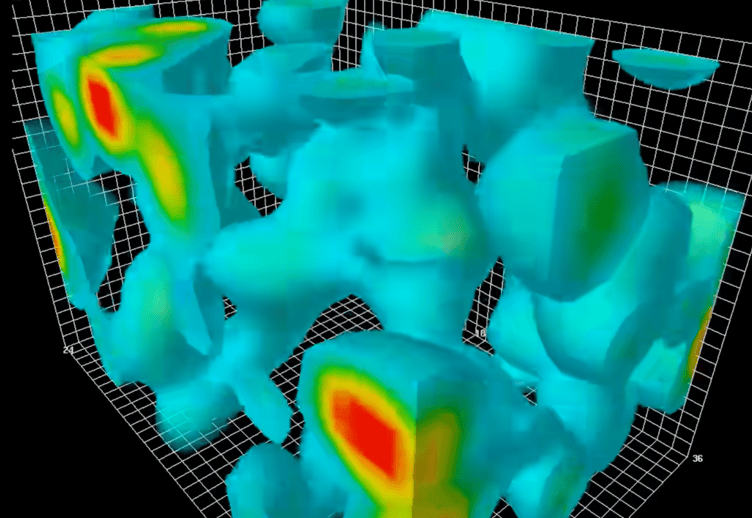
This is a simulation of vacuum alone. It is actually full of these fluctuations happening all the time. However, it is possible to create a true vacuum by clearing out all fundamental particles but a little hitch in the plan, is the amount of energy required to actually do this. And even if you did manage to acquire this much energy, you would find that a truly empty vacuum is unstable and would resort to its stable form with field fluctuations very quicky.
This demonstrates just how poorly we understand the universe around us. Quantum mechanics has opened the door to an entirely new realm of mysteries. It forces us to rethink our assumptions and view reality from a completely different perspective. After all, how many people would imagine that something as seemingly empty as a vacuum is actually filled with fundamental particles and quantum activity? As strange as these discoveries may seem, they are only the beginning. Our journey into the quantum world has just begun, and its greatest secrets still lie ahead. We are yet to find out how they fit with classic Newtonian physics or even our modern lives, but quantum mechanics has proven useful in new inventions which would not be possible if not for the laws of quantum.
 Everyone Wants to Know