As a Londoner, I often find myself comparing the regal Victorian architecture in places like Bank and Regent Street to the high-rise modern apartments in Southwark and Canary Wharf. The beauty of the regency architecture is unparallel as it brings a sense of class and grandeur. In contrast, the modern skyline is functional with its ergonomical design. No points for guessing my favourite form – keeping the classical architecture but adding the necessary modern twists (like insulated walls and draft management). However, thinking about architectural science, there is little comparison of the wonders created thousands of years ago. When compared, one could argue that the application of geometry and its execution may not have attained the same level of precision as witnessed 4000 years ago.
Take the pyramids of Giza. It is common knowledge that the stones used were enormous and weighed around 15 tons each. Without modern cranes, transporting these boulders is a massive feat in itself. However, it is only when we look closer that we can truly marvel at the oldest wonder of the world. If one took the slanting height of the pyramid and divided it by half of the length of the base, you get a number suspiciously close to the golden ratio (about 1.68). To highlight the magnitude of this discovery, the golden ratio (phi) was only discovered by the Greeks 2000 years later. It creates a mathematically perfect monument with visually appealing proportion. It also has close links to the Fibonacci sequence as the ratio of consecutive Fibonacci numbers converges towards phi. This shows that a complex level of geometry was perhaps subconsciously, perhaps purposefully applied in building these towering sculptures.
Another Greek mathematical term that everyone is familiar with is pi. Founded in 250 BCE, it has been integrated in our society for just under 3000 years. But when the Egyptian slaves were building these pyramids in 2500 BCE, how did they know about this theory? The (perimeter of base)/(2*height) is almost exactly equal to pi for every pyramid. So, how was this possible? Was it an understanding of complex geometry or a simple coincidence? One may belive it is the latter, but when we discover some more of the pyramid’s hidden features we may think differently.
The four points on the base of the pyramid are aligned to the True North, South, East and West. The True North is different to the magnetic North which changes. A standard compass only shows you the magnetic North so in a world without GPS you would need to rely on tracking the shadow of the sun during spring and autumn equinoxes. This is when the Sun is directly above the equator and the day and night are equal. The Autumn equinox illuminates a path from the East to the true West which can be traced and eventually points out the True East and West.
The base itself perfectly matches the curvature of the Earth, making it pretty straight for a monument without blueprints, floorplans or drone technology. Each side has an average error of only 58mm. In a monument this big and in a civilization without basic measurement tools, this fine error margin is remarkable.
Another wonder is the concaveness of each side of the pyramid. It is known as the only 8-sided pyramid in the world. As it is consistent on all four sides and all three pyramids, it can be assumed that this design was intentional. Not only is the architecture of this extremely difficult but the subtlety of it is worthy of study. It is only visible under certain lighting like the spring and autumn equinox. The sun casts a shadow that splits each face into light and dark halves. This adds to the idea that the design was linked to solar symbolism and astronomical observations.

It is not only these pyramids that deserve to be marveled at. Other structures like the Incan empire’s settlement high up on Machu Picchu in Peru is also a place of scientific study.
The Incan city was built between 1438 and 1533 in the heart of the Andes in Southern Peru.
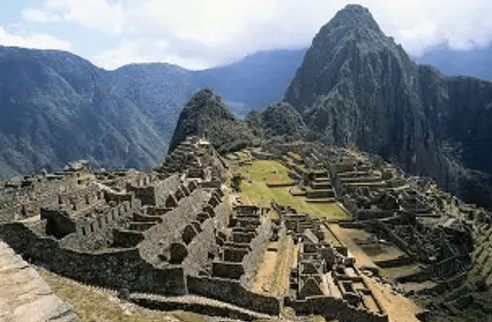
These stones are heavy; each one weighs about 20 tons per stone. Machu Picchu is just under 2500m, so how did the Incans actually get the stones that high up. Not only that, but the nearest quarry is the Cachicata quarry, 32km away. This is roughly a 3-day hike but most likely even longer carrying each of these stones. The land itself is tectonically active and prone to earthquakes and landslides. Making it difficult to build on and even more difficult for the stones to stay stable for half a millennium.
The stones were carved with such extraordinary precision that they fit together perfectly without the need for mortar or cement, yet the structure withstood seismic activity for over 600 years. In a time before iron tools existed, it is remarkable to consider how these tough rocks were shaped without error. The real beauty of the site lies under the ground – 60% of is foundations and drainage. Each structure is supported by strong, well-built foundations, helping the site endure frequent earthquakes. The city also contains one of the most sophisticated drainage systems in architectural history. Its entire water supply originated from a natural spring on the northern slope, carefully channelled to provide a steady flow. This system includes drainage outlets and a 749-meter network of channels that direct runoff, preventing flooding while supporting agriculture. This advanced drainage design is a key reason why Machu Picchu remains so well preserved today.
There are several ancient engineering marvels that leave us awestruck even today. To me, these creations are far more than simply a tourist destination, they are a sight to study and respect. With minimal resources and technology, but sheer grit and intelligence, they put together the world’s oldest wonders. It teaches us that sometimes the best form of learning is from our past.


 Everyone Wants to Know