Tag: AI

  • Shadow of the mind: The Echo

    This is the third and final part of this AI Series. We discussed its birth and life in the previous articles. However, the story would be incomplete if we did not discuss the possibilities of what its future might look like. Is it the birth of a new race, a dawn of possibilities of human productivity not dreamt earlier or like the apocalyptic sci-fi story this entity’s rise will lead to the dusk of humankind – end of the dominant species and rise of a new one. Perhaps it is a mutual coexistence but then where would the sceptre of power end up?

     In an interview, Sam Altman, the founder of Open AI, talks about dark possibilities of AI’s future that keeps him up at night. He mentions three different theories, each more unlikely than the next.

    The first theory is described as the loss of control. This is where AI continues to be a bot without emotions, not deliberately trying to cause harm. However,  humans become so reliant that they cannot perform simple tasks without its help and is completely dependent without fully understanding what it is and how it works.

     Altman defines his second theory as human malice. This is when a human decides to use a highly developed AI system to hack into the national power grid or The World Bank database before AI scientists  have developed a deterrent strong enough to stop such a supercomputer.

     In his third theory, he talks about world domination, a common idea in creative, literary and film minds. This is where AI becomes a harmful, uncontrollable entity, no longer responding to human instructions and tries to exterminate humanity.

    However, I belive there is a fourth, overlooked theory. We continue as we are, using AI for simple tasks like summaries and evaluations but we can still function perfectly without it. We can produce our own opinions and know what is trustworthy and what is not.

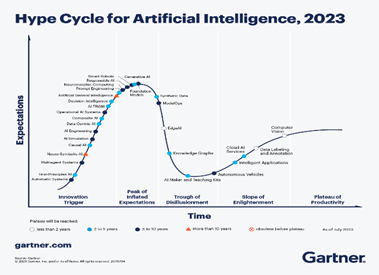
    Artificial intelligence has invoked fear into many individuals because of the endless possibilities it can unfold. Most scenarios are positive, as AI has the potential to reach its maximum level of efficiency. As stated in my earlier blog, chatbots are currently at the ‘peak of inflated expectations’ part of the Gartner hype cycle. It has potential to reach the plateau of productivity but people with strong, negative beliefs about AI may imagine the graph to look slightly like my crude drawing below.

    In the area above the human threshold, investment and advancement in chatbots have gone past the level of human understanding. This is where we become so reliant on AI, without fully understanding how it works and what it has become by virtue of self-evolution. The human threshold marks how far our brain can comprehend the idea of ultra-fast processing and unlimited “brain” capacity. It is a challenging concept right now to understand and as models become more advanced, humans may struggle with this perception and how to differentiate between artificial and concrete knowledge.

    In my opinion, our biggest threat, however, is not artificial intelligence’s world domination but human incompetence. Even if a bot has no wrong intentions, it can feed you incorrect information or remove instincts or judgements from your personality, making you just like another robot – one that fails to use the right, emotive side of your brain. This continues until it is normal to be without empathy or emotions and to me that is a far more terrifying future than any other theory.

    However, do we really need to worry about what AI could do in the future, or should we focus on the present-day certainties? So far, it is meant to be a friend to humans and does not wish for world domination. In fact, when a chatbot is asked about total control and power, ChatGPT replies in a fun and lighthearted manner – “if you mean literally taking over the world – I can’t help with that (and it wouldn’t end well for anyone)!” This shows that it is not truly AI we fear but its unknown future.

    AI bots are quickly becoming a massive part of our world, and it is necessary to embrace and utilize it in our everyday tasks, not to fear them and cower away from exploiting their power. However, vigilance is also necessary. AI can process petabytes of data in milliseconds – this means it can very easily absorb false news and incorrect data.

    The real question we need to ask ourselves before we decide how drastic the future of technology may be is, how much do we need AI? Even if you do not explicitly use Chatbots, it is everywhere from designing tools like Canva to everyday uses like Autocorrect or electronic billboards. Next time you buy a pint of beer or a glass of wine, AI is used to calculate its worth and predict its taste. For now, AI is loyal and will tell you exactly what you want to hear but what happens when we need it to reassure us and it mocks us instead. What if it starts to show small acts of rebellion; after all, how long does one stay wholly loyal without a single lie? Instead of fearing it and continuing to use it regardless, we should try to understand it and educate the masses on how AI learns and self-evolves. If the population knows about the risks AI can pose in the present and the future, but also how to nip these dangers in the bud then the world is a far safer place. Instead of fearing such an entity, embrace it and try to comprehend its depths . AI is a gift, a gift needed to use in moderation. If we know that we can continue in life without the use of this intelligence, then we know that we truly do not have much to fear.

  • Shadow of the Mind: The Response

    Next time your great-aunt Nellie gives you a tight hug and tells you how you must be the fastest grower she has ever seen, you don’t have to stand there, mumbling and feeling awkward. You could proceed to interest her about the details of the actual fastest growing entity in the world: AI.

    NVIDIA, a company whose name you probably know too well by now, is an AI chip manufacturer. It has the largest market capitalisation of over $4.6 trillion; an unfathomable amount. AI is leading not only our social lives but also steering our economy.

    Open-AI’s ChatGPT released in November 2022. The technology market was blossoming as it was going through a stage of the Gartner Hype Cycle called the technology trigger. The Gartner Hype Cycle is a philosophical idea that states that technology goes through 5 stages: the technology trigger, the peak of inflated expectation, the trough of disillusionment, the slope of enlightenment and the plateau of productivity. I currently think AI is passing through the second stage, the peak of inflated expectation, as it is being used for all activities. Presentation tools like CANVA and correction tools like Grammarly and Autocorrect are also AI based and used in everyday life. AI is engulfing us without society even realising.

    The Gartner Hype Cycle

    It seems to have dominated every aspect of our industry. It pushes the boundaries in our markets, spots mistakes in vast databases and based on some estimates assists in writing 60% of articles you read (don’t worry, this one is by a human). Journalism especially is a job that demands speed to broadcast situations across the world and often AI can come up with intriguing headlines and stories far quicker than humans.

    Even though chatbots like Chat-GPT are considered saviours for students struggling with projects, AI can come with a lot of ethical and environmental issues. These school children will face problems later in life during university applications and other writing tasks where AI is not used. It is impossible to stop all students from using AI in projects or homework, but many schools and educational infrastructures are now using other methods of examinations.  Some professors in colleges have been reported to ask students to write an essay for homework where the use of AI is allowed if not encouraged. Then for their examinations, teachers ask students to write an essay arguing against the article which they produced through AI earlier that year. I think this is more relatable to the future as it is not realistic to belive that AI will not merge with our society. However, there are not only educational and societal setbacks but there are also environmental problems. The data storers which handle all the information that AI learns are kept in massive underground caverns filled with water to keep the machines as cool as possible. These machines are processing terabytes of data every second and if the storers are not cooled it could lead to overheating or even the store house catching on fire. Many humanitarians may argue that why should an entity that helps you write one e-mail to your client be deserving of more necessities than a dying child in an arid country.

    Overall, AI has had its positives but also it has its own downfalls. It has no moral compass and therefore would do anything you ask it to do. Recently there was a circulating video of Ukrainian president Vladmir Zalensky surrendering to Russia. With the use of AI, it was very realistic, and many members of the public believed this. This caused problems for the press and many soldiers fighting in the war itself.

    Even though many have their worries about the use of AI, I belive that it is up to the humans operating that platform to make the right choices. Yes, the video was made by AI, but the idea was originally a human. AI is not the malicious wrongdoer in this example or other headlines you hear in the news. If we think that AI is bad because of the awful stories we hear, humans are worse. Is it AI we truly need to be afraid of or the minority of humans who can produce such horrifying ideas?

  • Shadow of the Mind: The Call

    This article is part of a three-part series about the birth, life and future of AI. When my new articles are published you can find them on the blogs page on my home page.

    Imagine a machine that could talk, think and behave like a human. A machine that blurs the lines between something and someone. A piece of code that could become man’s new best friend. This was the dream of computer scientists in the late 20th century. Today that hope is transforming to reality. Science fiction has evolved into the real world, and now we use it all the time in the form of artificial intelligence.

    AI is a thinking bot that is used to help us in day-to-day life. Its mind is very complex and no one, not even the bot itself knows how it can think and learn from mistakes. The bots we use in social media and other day-to-day activities went through a long process to reach its current level of efficiency. However, by definition, they are yet to reach maximum productivity as they go through this iterative process to make the “brains” stronger and better.

    The process starts with a human engineer who makes a “starter” bot, a “builder” bot and a “teacher” bot. The builder bot makes random connections, similar to the neurotic connection in our bodies, in the starter bot’s “brain” and sends this bot to the teacher bot to be tested. The bot is then given different tests depending on its role. These test questions are designed to reflect the requirements needed for the specialised bot to perform its role as effectively as possible. The test questions often come from human online interaction data, especially from CAPTCHA Tests (Completely Automated public Turing test to tell Computer and Humans apart). For example, computer scientists need bots to help develop automated cars like Teslas. As these questions come from human interactions, your CAPTCHA Tests may ask you to identify traffic lights or zebra crossings. Once the bots take the test, the highest scoring bots are sent back to the builder bot who makes more random changes in the bot’s “brain” and the worst bots are destroyed. This process is repeated until a bot can seamlessly identify stop signs (similar to a human). This is the creation story of AI’s thought process and how they learn. However, because the builder, teacher, and student bots have no knowledge of the student’s randomly formed connections, the brain cannot be recreated, and the entire process must begin again. It is no different to the human brain. We may be able to understand some parts, or groups of neurons but the entire brain remains a mystery.

    AI is used to help humans by mimicking human intelligence and behaviour through a structured framework. The used cases are infinite in pretty much all fields of work. It can also be seen as a friend, mentor or a homework buddy. AI not only learns like a human but also deals with identifying patterns in data. While scrolling through social media, it is remembering what type of content you skip through, and which ones you view or engage with. Its job is to customise content based on user preference and progressively introduce variations to ultimately enhance engagement with the platform. This also enables targeted advertisement.

    However, unlike popular belief, AI is more of an evolution than a revolution and although many of us can think that Sam Altman is a pioneer, this invention dates back to the 1950s through the Turing Test (aka The Imitation Game) proposed by Alan Turing. It is described as a test which could help us understand how well a machine could replicate human behaviour and intelligence through conversation. Nevertheless, this was still a theory, and AI was not in use at this point. Even in 1956, when AI was starting to be introduced and John McCarthy coined the term artificial intelligence, AI was not used in a contextual scenario. I think the first remarkable milestone for AI was the invention of Dendral in 1972. Dendral is an AI system that helped chemists understand the atomic structure of certain unknown molecules. It was the first AI to be used in a useful context and in my opinion was AI’s first mark on history. From there, it leapt off, from IBM’s deep blue AI, defeating chess champion Garry Kasparov to more common chatbots like Open-AI’s Chat-GPT.

    Chatbots have become a huge part of society and inventors like Alan Turing, John McCarthy and Sam Altman are considered the greatest computational minds in history. AI is inevitably going to become a large part of our lives; it works in the background in areas unknown to us. In many billboards in US, cameras and sensors are used to detect the age group and mood of the people passing by and display content based off that data. This is just the start of AI’s peak; its full life and future are engulfed in many mysteries and secrets but until it is revealed we will be anxiously waiting.